Staffing agencies have a headcount reflex. When volume increases, the default response is to hire another recruiter. But every new recruiter costs $60K or more per year, and a significant portion of their time goes to admin, not placements. They are drowning in admin: reformatting resumes, chasing timesheets, copying data between systems, and coordinating interview schedules across time zones. The tech stack is a Frankenstein stack held together by duct tape and Excel. Everyone is doing "work about work" instead of filling roles.
The numbers tell the story. The industry average time-to-fill is 63.5 days. Agencies using automation compress that to 21 days, a 38% reduction. The question is not whether to automate, but which automations to implement first. This post covers the five highest-impact automations for staffing agencies, what each one replaces, and the measurable results you can expect. For the full industry overview, see our staffing and recruitment page.
The agencies that scale successfully are the ones that scale systems, not headcount. Hiring another recruiter to handle volume is like adding another bucket to bail water from a leaking boat. At some point, you have to fix the hull. The same headcount-versus-systems tradeoff shows up in neighbouring service businesses; if you run an insurance brokerage or a digital marketing agency, the bottleneck is different but the pattern is the same.
1. Automated resume formatting and client submission.
The manual process takes 15 to 30 minutes per resume. Strip contact info, adjust fonts, add agency branding, write an executive summary. A junior recruiter can spend 3 hours a day just formatting. For an agency processing 200 resumes per week, that is 60 to 80 hours of non-billable labor, roughly $8,500 per month in wasted recruiter time. And speed matters: a 2-hour delay means a competing agency submits first and wins the placement fee.
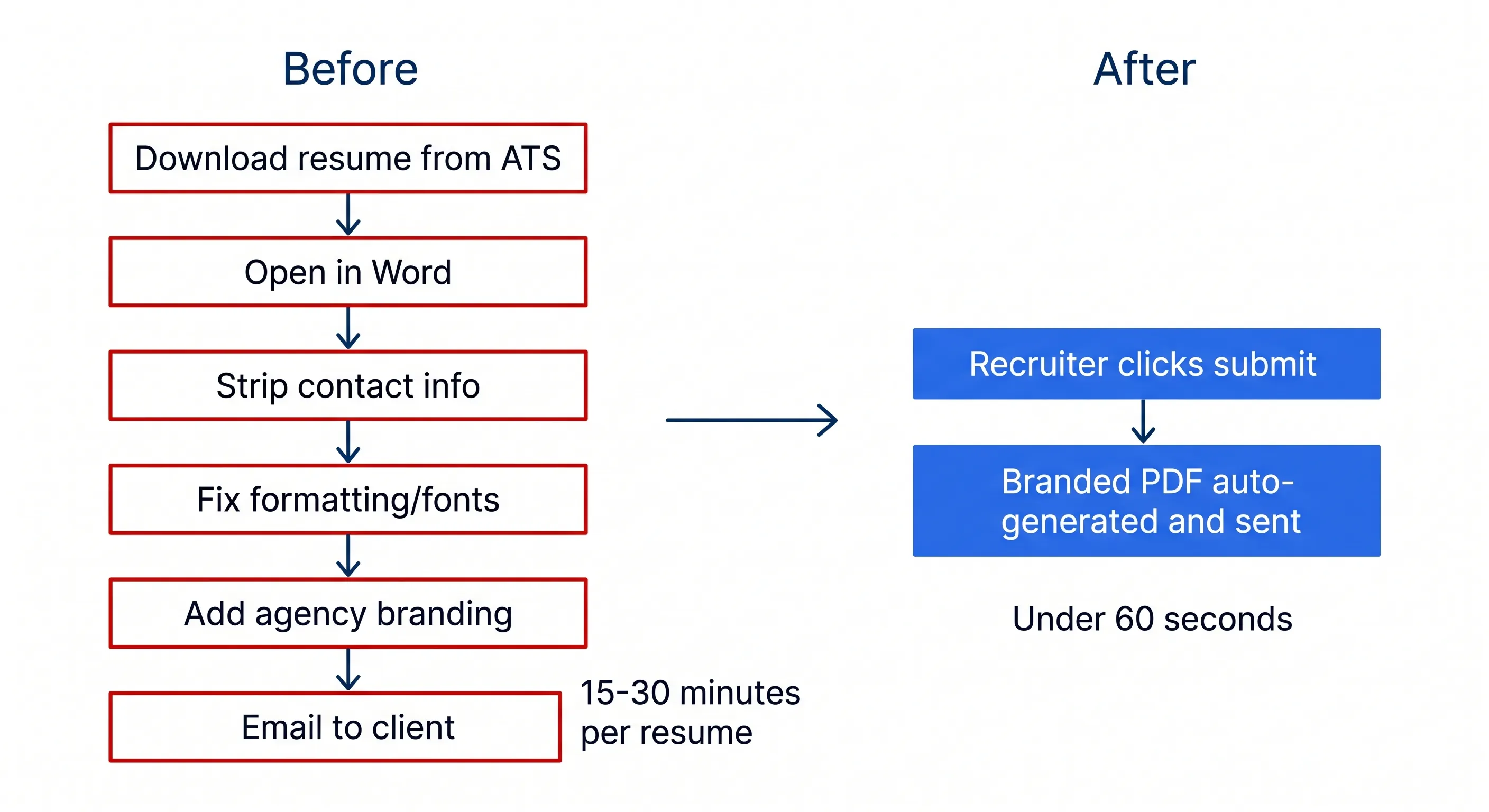
What automation looks like: the recruiter screens a candidate and clicks one button. The system extracts work history, normalizes the data, strips PII, rewrites the executive summary against the job description, and applies the agency's branded template. The entire process takes seconds instead of half an hour. Result: 85% reduction in formatting time. For a 20-person team, this can recapture roughly 100 hours per week. Submission volume increases by 51%, which means more candidates in front of clients, more placements, and more revenue from the same team.
2. Candidate rediscovery and database mining.
Recruiters spend 4 to 6 hours per day sourcing externally, cycling through multiple job boards and LinkedIn tabs. The industry calls it "tab fatigue," and it is one of the biggest drains on productive time. Meanwhile, thousands of qualified candidates sit untouched in the ATS database. Agencies pay for job board ads to find candidates they already have because legacy ATS search is keyword-only and misses relevant candidates who were tagged differently. A project manager with "delivery lead" in their title never surfaces in a keyword search for "project manager."
What automation looks like: semantic search across resumes, notes, and tags. Not keyword matching. The system surfaces candidates by meaning, not exact terminology. It understands that "delivery lead," "program coordinator," and "project manager" can describe overlapping skill sets. Allen Recruitment found that 60% of successful placements originated from the internal database after implementing rediscovery tools. Cost-per-hire drops 20% to 40% because you are sourcing from candidates you have already screened and vetted. Rediscovered candidates also have 46% higher lifetime value because they already have a relationship with your agency.
3. Timesheet collection and payroll processing.
Every Monday and Tuesday, back-office teams enter the same cycle: chasing timesheets from contractors, verifying client signatures, and reconciling pay rules across different contracts. Manual data entry between ATS and payroll creates margin leaks that are difficult to detect until they compound. A single transposed digit means a contractor does not get paid on time, and they walk to the agency down the street. Payroll inefficiencies cost agencies $70,000 over three years when you account for correction cycles, late payment penalties, and contractor attrition.
What automation looks like: timesheets get collected digitally, matched against approved hours, and pushed into payroll without manual intervention. Discrepancies get flagged before checks go out, not after. Overtime rules, split shifts, and multi-rate contracts are calculated automatically. The result is an 80% reduction in processing time and 79% fewer overtime calculation errors. Back-office staff move from data entry to exception handling, which is a far better use of their expertise.
4. Interview scheduling and feedback loops.
Scheduling interviews is deceptively time-consuming. Each recruiter spends 1 to 2 hours daily coordinating schedules across time zones, managing 5 to 8 email exchanges per candidate just to confirm a single meeting. Multiply that across a team of 15 recruiters and the agency is burning 15 to 30 hours per day on calendar logistics. The real cost is not just the time; it is the speed. A scheduling delay of 2 days nearly guarantees the candidate accepts a competitor's offer, especially in high-demand verticals like tech, healthcare, and skilled trades.
What automation looks like: calendar integration with automated SMS and email sequences. The system checks availability across all parties, proposes time slots, sends confirmations, and handles rescheduling without recruiter involvement. Automated reminders reduce no-shows. The results: 28% higher candidate show rates, 45% reduction in scheduling conflicts, and 93% of candidate conversations completed within 1 hour using automated scheduling. Recruiters get their time back to do what they were hired for: building relationships and closing placements.
5. ATS-to-VMS bridge automation.
The VMS black hole is one of the most frustrating bottlenecks in staffing operations. Recruiters copy-paste job descriptions from the client's VMS portal into their ATS, then manually download candidate resumes from the ATS to re-upload into the VMS. Submittals disappear with no feedback. Status updates require logging into a separate portal and manually checking each submission. This is one of the most significant losses of recruiter productivity in the industry, and it happens dozens of times per day at agencies with large managed service provider (MSP) clients.
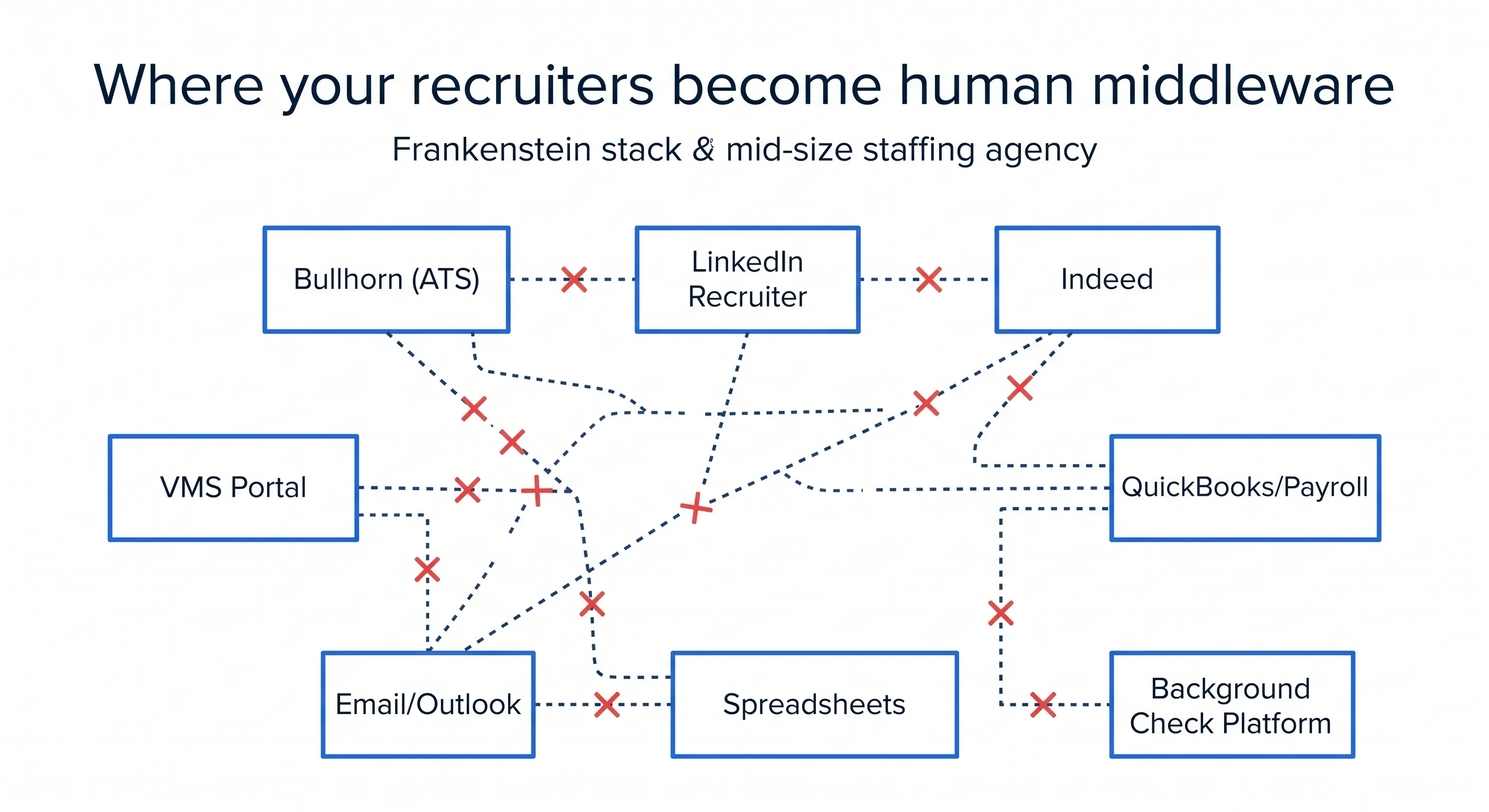
What automation looks like: job orders flow from VMS into ATS automatically. Candidate submittals flow back. Status updates sync both directions in real time. No more copy-pasting between portals, no more logging into five different systems to check on the same candidate, no more submittals vanishing into the void. Recruiters see the full pipeline in one place and can focus on winning placements instead of managing data entry across disconnected tools.
Where to start and what to expect.
Implementation does not happen all at once. The agencies that succeed follow a phased approach with clear milestones and measurable outcomes at each stage.
Days 1 to 30: Map the candidate lifecycle from first contact to placement. Run data migration and hygiene against your ATS records. Deploy resume parsing and formatting automation. This is the highest-impact, lowest-risk starting point because it touches a well-defined, repetitive process with clear before-and-after metrics.
Days 31 to 60: Activate communication automation for candidate outreach and follow-ups. Deploy interview scheduling. Begin the database cleanup required for candidate rediscovery. This phase builds on the data foundation from month one.
Days 61 to 90: Activate AI-powered candidate matching and rediscovery. Configure reporting automation so leadership has real-time visibility into pipeline metrics. Measure ROI against the baseline captured on day one.
Common mistakes to avoid. First, automating broken processes. A faster broken process is still broken. If your intake workflow has fundamental gaps, automation will just move candidates through those gaps faster. Second, attempting five workflows simultaneously. Agencies that try to automate everything at once have a 70%+ failure rate. Start with one, prove the value, then expand. Third, launching without clear success metrics. If you do not measure time-to-fill, submission volume, and cost-per-hire before you automate, you have no way to prove the system is working.
The dirty data problem. Your ATS data is probably a mess. Duplicates, outdated phone numbers, candidates tagged with the wrong skills, notes from recruiters who left years ago. This is normal. Data cleanup is part of the engagement, not a prerequisite. We audit your records, identify the gaps, and clean the data as we build. You do not need to spend months preparing before the project starts. We work with staffing and recruitment agencies across Calgary and Western Canada, and for context on how this affects pricing, see our transparent breakdown of AI costs.