"How much does AI cost?" is the question every business owner asks, and every vendor answers differently. One quotes a monthly SaaS fee. Another quotes an hourly consulting rate. A third quotes a fixed project fee with a six-figure number attached. The result is that business owners have no baseline for what is reasonable, no way to compare proposals, and no framework for deciding whether a quoted price reflects genuine value or inflated margins.
The opacity is measurable. Roughly 85% of enterprises fail to forecast AI implementation costs within a 10% margin. About 25% miss their estimates by over 50%. These are not small miscalculations. They represent the difference between a project that delivers ROI and one that becomes an expensive write-off. The problem is not that AI is inherently unpredictable. The problem is that most buyers do not know which questions to ask or which cost drivers actually matter.
This post breaks down the real cost drivers, market benchmarks, and ROI frameworks so you can evaluate any proposal intelligently. This is educational, not a sales pitch. The goal is to give you enough context to walk into any conversation with a vendor, consultant, or internal team and know whether the numbers make sense.
What determines the cost of a custom AI system?
AI project costs are driven by six primary factors. Understanding each one will help you estimate where your project falls on the spectrum before you talk to anyone.
Complexity and architecture tier. This is the biggest determinant. Industry benchmarks range from $5K to $15K for a simple API integration, $15K to $35K for task-specific automation, $35K to $75K for multi-system workflow automation, and $75K to $200K+ for full operational transformation involving multi-agent orchestration. The jump between tiers is not linear; each tier introduces new infrastructure, testing, and reliability requirements.
Data readiness. This is the cost most people miss entirely. Data cleanup, normalization, and preparation consume 30% to 50% of the entire project budget. If your data lives in spreadsheets, legacy databases, and email threads with no consistent structure, the work required to make it usable for an AI system is substantial. This is not optional overhead. It is foundational work that determines whether the system produces reliable results or expensive garbage.
Integration requirements. Connecting an AI system to your existing tools (CRM, ATS, ERP, email, internal databases) costs $20K to $80K for mid-market businesses. The more systems involved and the older those systems are, the higher the integration cost. Custom API work against undocumented or poorly documented vendor APIs adds time and risk.
Model selection. The choice of AI model directly impacts ongoing operational costs. Input tokens currently range from $0.15 to $5.00 per million tokens depending on the model. Output tokens cost 3x to 5x more than input tokens. A system that routes all traffic through a single frontier model will cost dramatically more than one using intelligent model routing, where simple tasks go to smaller, cheaper models and only complex tasks hit the expensive ones.
Ongoing maintenance. Plan for 15% to 30% of the initial build cost annually. This covers model monitoring, retraining as your data evolves, drift correction when model performance degrades over time, and infrastructure costs. AI systems are not "set and forget." They require ongoing attention to maintain accuracy and reliability.
Change management. Budget 8% to 15% of the total project cost for training, documentation, and adoption support. The best AI system in the world delivers zero value if your team does not use it. Change management includes building internal champions, creating training materials, running workshops, and iterating on the user experience based on real feedback.
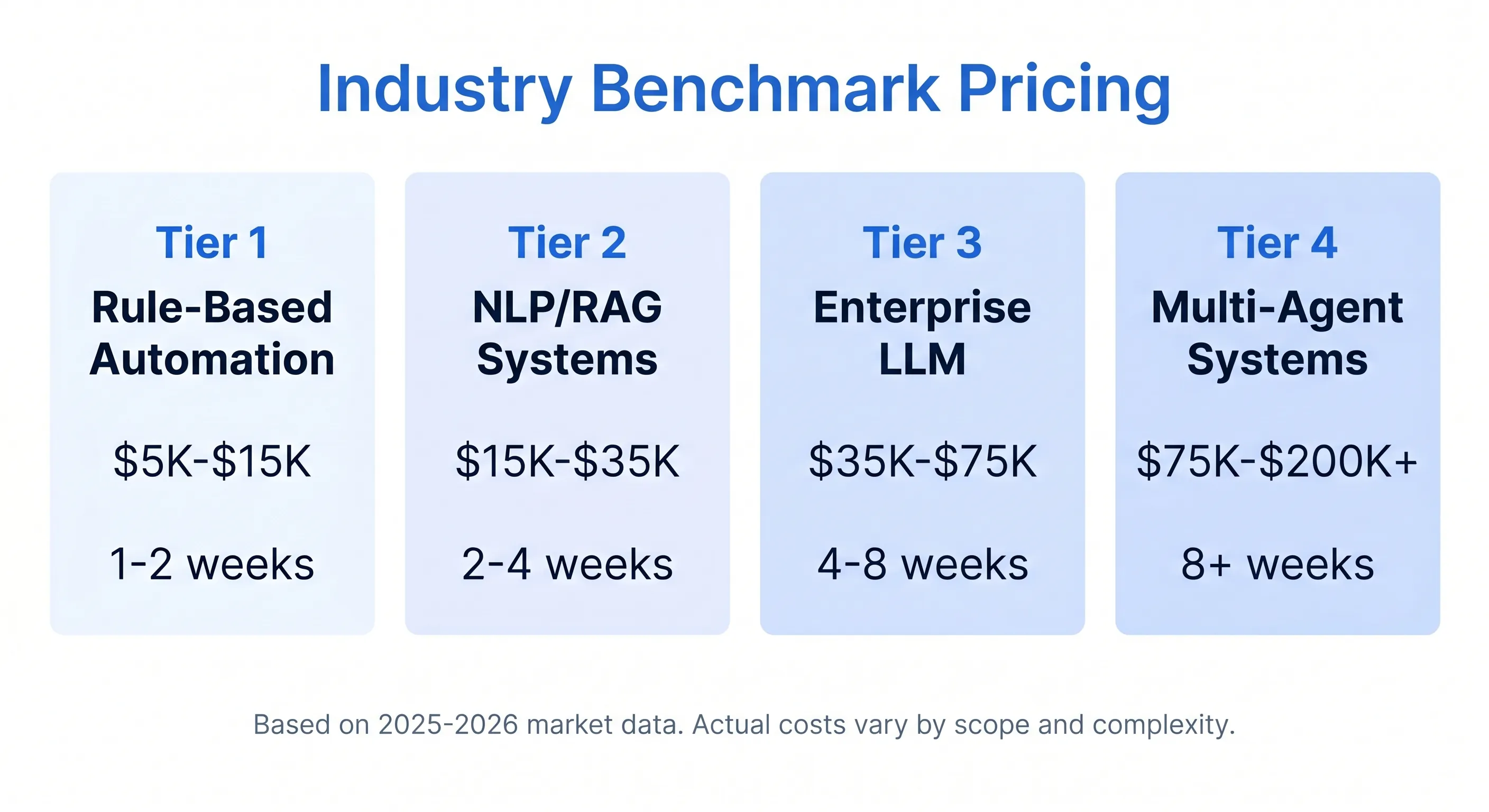
These ranges reflect current market benchmarks across the AI consulting industry. Steelhead's pricing falls within these bands, with most engagements landing in the lower portion due to AI-assisted development reducing build time and cost. Specific scope and pricing for your engagement are determined during paid discovery.
Tier 1: Simple API integration ($5K to $15K). This covers connecting to a foundation model API, writing and testing prompts, and building a basic interface. Example applications include a customer support chatbot that answers frequently asked questions, an internal tool that drafts email responses from templates, or a simple classification system that routes incoming requests to the right department. These projects are typically completed in 2 to 4 weeks.
Tier 2: Task-specific automation ($15K to $35K). These systems handle multi-step tasks, make decisions based on intermediate results, and integrate with one or two existing tools. Example applications include an agent that processes inbound leads by researching the company, scoring fit, and drafting personalized outreach, or a system that ingests meeting notes and automatically creates action items, assigns owners, and updates project management tools.
Tier 3: Multi-system workflow automation ($35K to $75K). This is where most mid-market projects land. RAG (Retrieval-Augmented Generation) systems, cross-platform integrations, and workflows that span multiple tools and data sources. Example applications include an insurance brokerage automating policy checking across hundreds of pages, or an internal knowledge base that lets employees search company policies, procedures, and historical decisions in natural language.
Tier 4: Full operational transformation ($75K to $200K+). Multiple AI systems coordinate across an entire workflow, handling handoffs, error recovery, and decision-making with minimal human intervention. Example applications include a staffing agency's end-to-end candidate processing pipeline, from resume ingestion through formatting, skills extraction, candidate matching, outreach drafting, and ATS updates, or a supply chain system that monitors inventory, predicts demand, generates purchase orders, and coordinates with suppliers.
Build vs. buy vs. hire: which path makes sense?
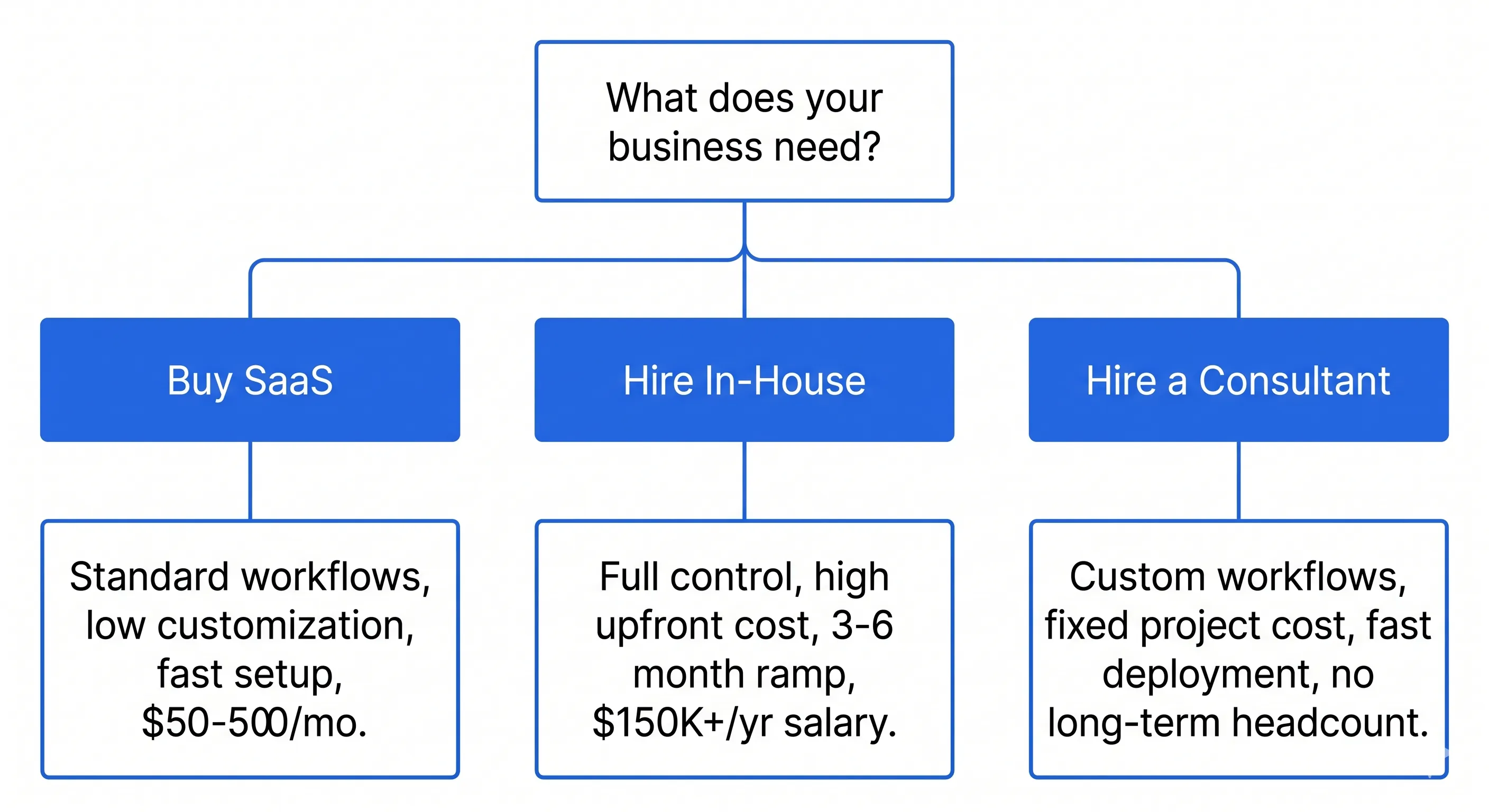
There are three paths to getting AI into your operations, and each one makes sense in different circumstances.
Buy (SaaS tools). Cost: $50 to $500 per month. SaaS tools offer 60% lower development costs and get you to market roughly 2 years faster than building from scratch. Off-the-shelf products cover approximately 90% of standard use cases: email automation, meeting transcription, basic chatbots, document summarization. The right choice when an existing tool solves your specific problem without requiring significant customization. The wrong choice when you need the AI to work with your proprietary data, integrate deeply with your existing systems, or handle workflows unique to your business.
Build (in-house team). Cost: $1.5M to $2.5M annually for a proper AI team (ML engineers, data engineers, DevOps, project management). Three-year total cost of ownership: $8.3M+. This path only makes sense at enterprise scale with proprietary data moats and a long-term strategic commitment to AI as a core competency. For a 50-person company, hiring a full AI team is like buying a commercial kitchen to make your morning coffee.
Hire (consultant, fixed project fee). Timeline: 3 to 6 months to production. Cost: 40% lower than a pure in-house build for the same scope. Best for mid-market businesses with specific operational bottlenecks that off-the-shelf tools cannot solve. You get a purpose-built system scoped to a measurable outcome, without hiring a permanent team or committing to enterprise-scale infrastructure. See how this works in practice.
For most small and mid-market businesses (20 to 200 employees), the realistic choice is between buying SaaS for commodity tasks and hiring a consultant for anything requiring custom integration with your existing systems. The two approaches are complementary, not mutually exclusive. Use SaaS where it works. Build custom where it matters.
The hidden costs most businesses miss.
The initial build quote is never the full picture. Here are the costs that consistently surprise first-time AI buyers.
Data cleanup and preparation: 30% to 50% of total budget. This is not a one-time cost. As the system encounters edge cases in production, you will discover data quality issues that did not surface during the pilot. Plan for ongoing data maintenance as a recurring line item, not a project phase that ends at launch.
Change management: 8% to 15% of total budget. Your team needs training, documentation, and time to adapt. Skipping this step is the fastest way to build a system nobody uses. The most expensive AI system is one that sits idle because the team reverted to their old process.
Security and compliance: 10% to 20% ongoing overhead. Data handling policies, access controls, audit logging, and compliance documentation add real cost. For regulated industries, this overhead is non-negotiable and should be budgeted from day one.
API cost scaling. Token costs increase non-linearly as usage grows. A system that costs $200 per month during the pilot might cost $2,000 per month at full production volume. Model routing, caching, and prompt optimization can reduce these costs significantly, but they require deliberate engineering effort.
Integration maintenance. Carrier and vendor API changes require ongoing updates. When Salesforce, Bullhorn, or any other platform pushes an API update, your integrations need to be tested and potentially modified. This is a recurring maintenance cost, not a one-time expense.
The "pilot to production" trap. A $50K pilot can escalate to a $240K production deployment when you factor in data readiness at scale, system stability and redundancy, compliance requirements, security hardening, and user training. Multiply any pilot estimate by 3x to 5x for a realistic total cost of ownership. If a vendor quotes you a pilot price without discussing the path to production, ask hard questions about what the full deployment will actually cost.
How to evaluate ROI before you commit.
AI ROI comes from four value streams. A strong business case should quantify at least two of them before you sign anything.
1. Cost avoided. Headcount deferred, manual hours eliminated, overtime reduced. If your team spends 40 hours per month on a task that an AI system can handle in 4 hours, the cost avoidance is straightforward to calculate. This is the easiest ROI to measure and the most common justification for mid-market AI projects.
2. Revenue unlocked. Faster throughput, more capacity without more staff, shorter sales cycles. If your team can process 50% more client requests without adding headcount, the revenue impact is direct. This is particularly relevant for service businesses where capacity is the binding constraint on growth.
3. Error reduction. Fewer rework cycles, fewer compliance incidents, fewer costly mistakes. In industries where errors have financial consequences (insurance, finance, legal), the cost of errors often exceeds the cost of the AI system that prevents them.
4. Compounding data value. Every interaction the system handles generates structured data that improves future performance. Over time, this creates a feedback loop where the system gets better at its job, which increases throughput, which generates more data, which makes it better still. This is the hardest ROI to quantify upfront but often the most valuable over a 3-year horizon.
The target payback period for SMBs is under 18 months. A marketing operations case study showed a 4.9-month payback period with 144% year-one ROI. A marketing agency automating reporting can recover 20+ unbillable hours per month, turning dead administrative time into billable client work.
Steelhead is based in Calgary and works with mid-market businesses across Western Canada. If you have specific questions about costs for your situation, the contact page FAQ already addresses common pricing questions. Or book a call and we will walk through the math for your specific use case.