Every agency owner knows the feeling. The first week of the month arrives and the entire team stops doing strategy. Account managers are copy-pasting numbers from six different tabs into a Google Sheet. The work is zero creativity, just busywork. Strategists become human middleware between platforms that should be talking to each other. The content pipeline is the 5-tool shuffle, and the whole tech stack is held together with duct tape and prayer.
Ninety minutes per client, per month. Some agencies pull data from over 800 files, paste into 150 spreadsheets, and manually update presentation decks 150 times a month. By the time the deck is presentable, the analyst has burned the cognitive energy they needed to actually interpret the data. The strategic work, the part clients are actually paying for, gets whatever is left over. And what is left over is usually not enough. If this sounds familiar, you are not alone; the full industry breakdown covers the systemic problems agencies face when their operations run on manual processes.
The cost is not just time. It is the compounding effect of your most experienced people doing work that requires no judgment, no creativity, and no expertise. They could be optimizing campaigns, building client relationships, or developing new service offerings. Instead, they are formatting pivot tables.
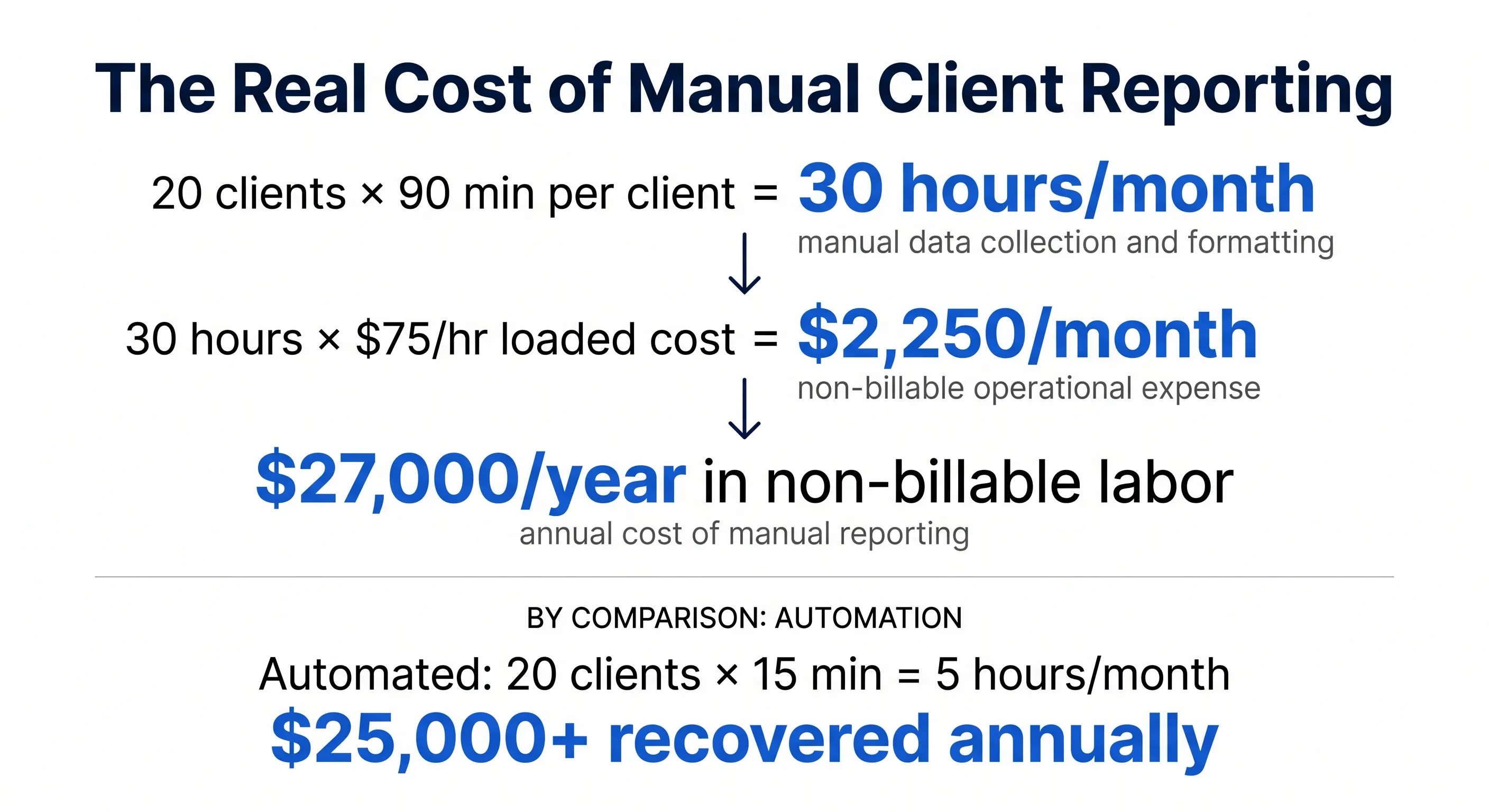
The math is straightforward, and it is painful. Twenty clients at 90 minutes each equals 30 hours per month of non-billable labor from a single account manager. At a blended rate of $75 per hour, that is $27,000 per year in lost productivity. For an agency with 50 clients, the number scales to 300 hours per month, equivalent to two or three full-time employees doing nothing but assembling reports.
An agency-wide reporting team of three people costs $78,000 to $174,000 per year in salary alone, before benefits, software licenses, or management overhead. And the output of all that labor is a deliverable that could be wrong. The data error rate from manual copy-paste workflows is high. One broken VLOOKUP formula can misreport thousands of dollars in ad spend. One transposed number in a budget pacing sheet can trigger an overspend that the agency absorbs out of pocket.
The downstream cost is even worse. Seventy percent of agency leaders cite transparent reporting as the core driver of client retention. When the reports are late or inaccurate, clients leave. The revenue lost from a single churned client often exceeds the entire annual cost of automating the reporting process.
Why dashboards alone do not solve the problem.
Most agencies have tried the dashboard route. The tools are well-known: AgencyAnalytics, DashThis, Looker Studio. Each solves part of the problem and introduces new ones.
AgencyAnalytics uses a per-client pricing model that becomes a "success tax" as the agency scales. White-labeling is restricted to the $479 per month tier and above. Global template synchronization is not available, so updating a report template across 50 clients means updating it 50 times. DashThis offers daily refresh only, not real-time data. Per-dashboard pricing reaches $409 per month for 50 dashboards, and deep data transformation is not supported. Looker Studio is slow with large datasets and frequently times out. It has no client portal, non-Google data sources require third-party connectors at $100 to $150 per month, and there is no native white-labeling.
The fundamental gap is this: dashboards show data, but clients want narrative. They want to know why metrics shifted, what happened, and what the agency is doing about it. The gap between raw data and client-ready insight is where all the manual hours go. No dashboard fills that gap on its own.
Then there is the attribution nightmare. Meta reports 50 conversions using view-through attribution. Google Ads claims 35 using last-click. The CRM shows 28 actual closed deals. There is no single beacon of truth. GA4 source/medium data is riddled with "(not set)" values. Consent Mode v2 is breaking tracking across the board. Analysts spend hours every month manually reconciling platforms just to prove the leads they generated actually closed. This reconciliation work is invisible to the client, but it consumes a massive share of the reporting budget.
What fully automated reporting actually looks like.
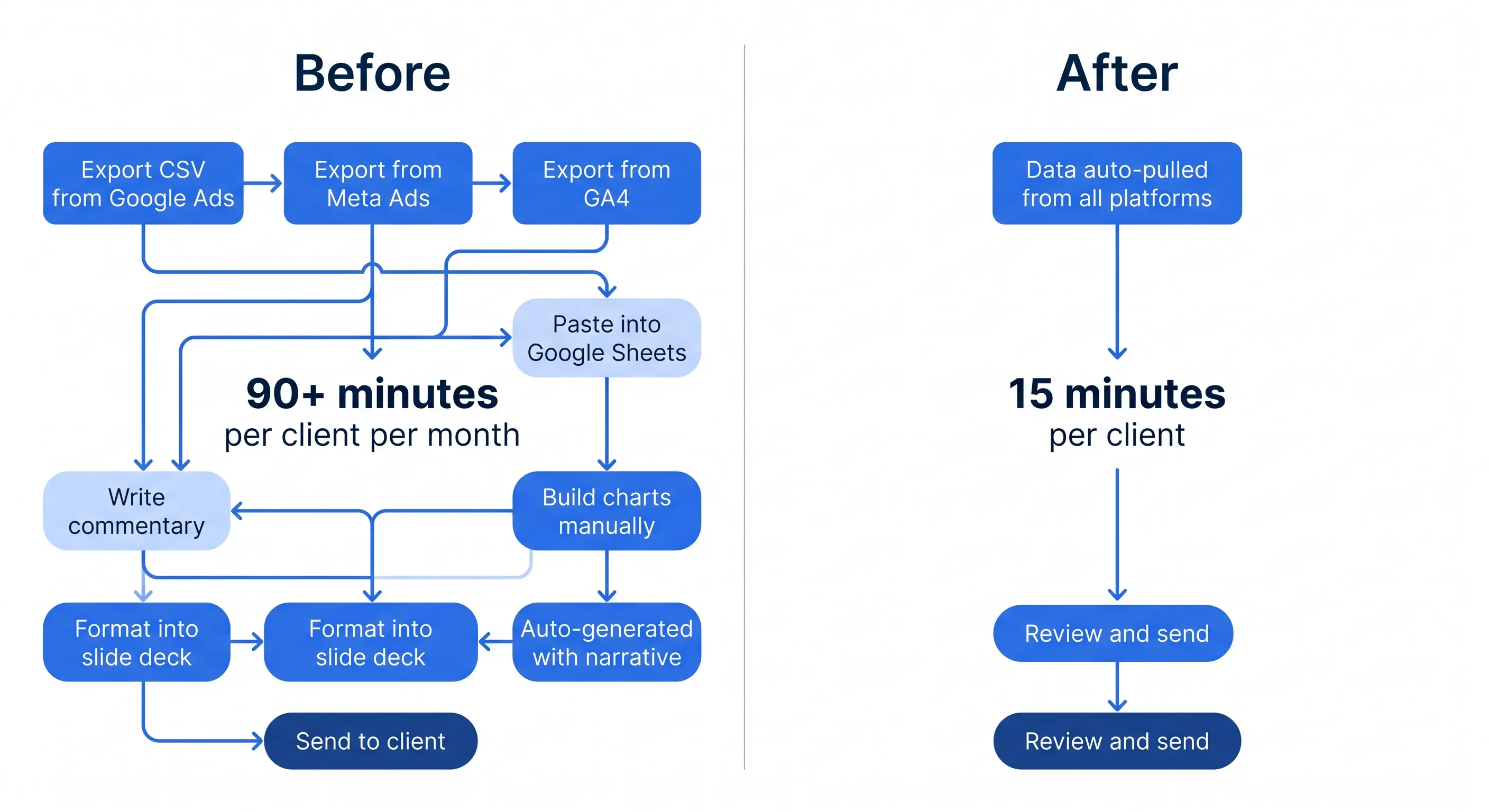
The pipeline replaces manual work at every step. First, API data pulls from Google Ads, Meta, LinkedIn, GA4, and your CRM. No manual exports, no CSVs, no copy-paste. The system connects directly to each platform and pulls the data on a schedule or in real time.
Second, cross-platform reconciliation. Algorithmic matching using deterministic, probabilistic, and fuzzy methods aligns conversions across platforms using standardized taxonomy mapping. The system resolves the discrepancies between Meta's view-through conversions, Google's last-click attribution, and your CRM's closed deals without a human touching a spreadsheet.
Third, anomaly detection. The system flags significant shifts before the report is built, not after. If a campaign's cost per acquisition doubled over the weekend, the system surfaces that before anyone starts formatting a slide deck. Fourth, LLM-generated narrative commentary. The AI drafts the first pass of the "why" narrative: what changed, why it changed, and what the recommended next steps are. Your strategist spends 10 minutes editing the insight that matters, not 90 minutes formatting numbers.
Fifth, auto-formatted deliverable. Branded PDF or dashboard, white-labeled to your agency, delivered on schedule. The client sees your brand, your voice, your insights. The difference is that your team spent 10 minutes on the strategic layer instead of 90 minutes on the data layer.
The results across agencies implementing this approach are consistent: 80% reduction in report preparation time. Data error rate drops from high (human copy-paste) to 0.05% systemic. Strategic bandwidth shifts from 20% to 100% of reporting time. Seventy-five percent of companies using AI for reporting shift their workforce to high-value strategic activities. For a full overview of how these systems fit together, see our solutions page.
Budget pacing and anomaly detection.
Media buyers managing hundreds of thousands in monthly ad spend across Google, Meta, LinkedIn, and Microsoft are doing it through fragile Google Sheets that calculate daily spend averages against monthly caps. These sheets break the moment a platform tweaks delivery speed. Buyers are locked in a spreadsheet for the first week of every month, drowning in client budget pacing calculations that should be automated.
The risk is real. One unnoticed weekend overspend and the agency absorbs thousands of dollars and a permanent dent in client trust. The client does not care that Meta's algorithm shifted delivery to Friday evening. They care that their monthly budget was exceeded by Tuesday.
Automation eliminates this entirely. Real-time spend tracking across all platforms against monthly caps. Automated alerts when campaigns drift off pace. The system catches a Friday evening overspend before it becomes a Monday morning crisis. Budget pacing becomes a background process, not a weekly fire drill.
Getting started without disrupting your clients.
Start with one bottleneck. For most agencies, that is monthly reporting. Do not try to automate everything at once. The implementation approach is designed to fit into your existing operations without forcing your team to learn new tools or change how they work with clients.
Data access is straightforward: read-only API credentials for your ad platforms, analytics, and CRM. No invasive integrations, no database migrations, no new software installations. Your existing tools stay in place. We build automation into Google Ads, Meta, GA4, HubSpot, Looker Studio, and your reporting layer. No new logins for your team.
Timeline: first automated reporting cycle within the same month you start. Full pipeline automation, including cross-platform reconciliation and LLM narrative generation, takes four to eight weeks. We work with digital marketing agencies across Calgary and Western Canada, starting with your highest-volume clients to demonstrate ROI immediately, then expanding across the roster. For context on what implementations like this cost, see our transparent pricing breakdown.